


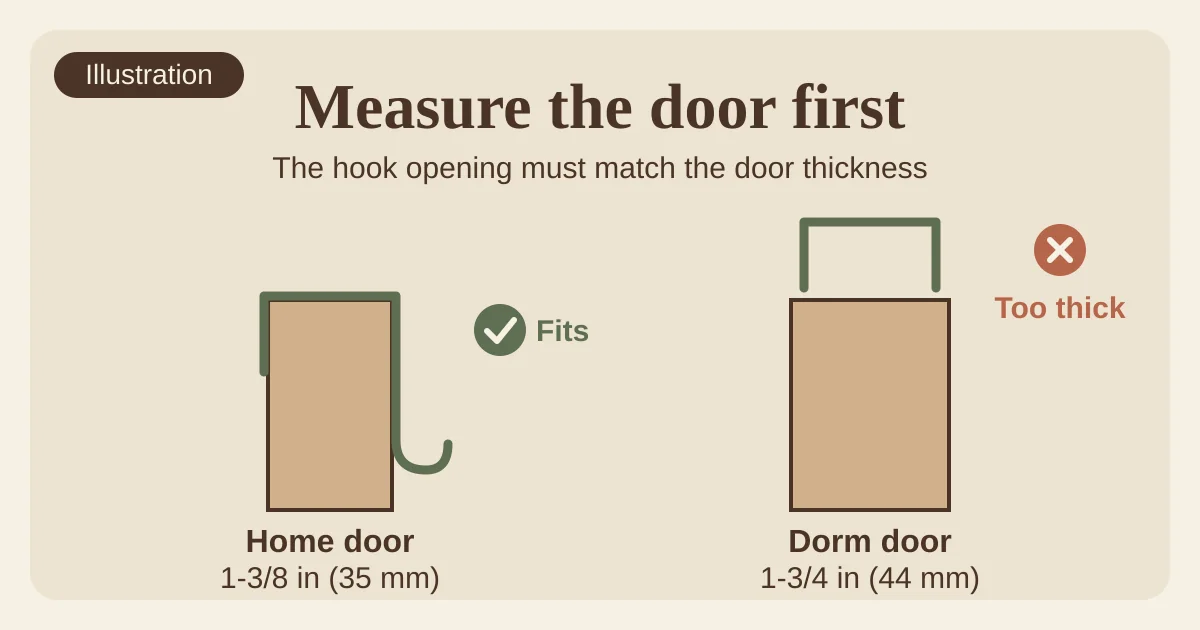
Your dorm closet probably has one rod, one shelf and a door with nothing on its back. That door is your easiest extra storage, if the hardware fits it. Good dorm closet organization on a door comes down to three numbers you can take with a tape measure in two minutes. The first is thickness: 1-3/8 in (35 mm) or 1-3/4 in (44 mm).
Short answer
For dorm closet organization on the back of a door, door thickness decides what fits. Most over-the-door hooks are made for 1-3/8 in (35 mm) home doors, while commercial-grade dorm doors are often 1-3/4 in (44 mm). Measure the door’s top edge, then the gap above the closed door, before you buy anything that hangs on it.
Who this guide is for
This guide is for a student or parent who wants hooks, a pocket organizer or a basket rack on a dorm closet door or room door, without drilling.
This is for you if
- Your room door or closet door is a flat, hinged door with nothing on its back
- Your housing rules ban nails and screws
- You are buying before move-in and can measure the door on a visit or ask housing for its thickness
Look elsewhere if
- Your closet has sliding or bifold doors: an over-the-door hook cannot sit on a door that folds or slides past another one
- You want a second rod or shelves inside the closet: this guide covers only the door
Measure first: three numbers
Door thickness decides whether a hook can grip the door at all, so measure it first. Skip it and you find out on move-in day, when the hook will not slide over the door.
Three numbers to write down
- Door thickness Open the door and hold the tape across its top edge, from one face to the other. Read it to the nearest 1/16 in.
- Gap at the top Close the door and look at the gap between its top edge and the frame. A US quarter is about 0.069 in (1.75 mm) thick: if one slides into the gap easily, a thin metal hook strap will usually pass. If it will not, hang nothing over that door.
- Depth behind the door Open the door fully and measure from its back face to the first thing it meets: the wall, the doorstop or the clothes on the rod. Whatever you hang must be shallower than that, or the door stops short.
Have your numbers? Check them in the Fit checker before you order.
How this guide was researched
Basellia built this guide from published door standards and over-the-door makers’ own fit specs; nothing here comes from product testing.
How we researched this
- In November 2026, Basellia compared makers’ published specs for over-the-door hooks, 24-pocket organizers and basket racks: the door thickness each accepts, its depth from the door and its weight limit.
- Door thickness comes from Allegion’s commercial door specifications. The top-gap limit comes from NFPA 80, the fire-door standard, as set out by Allegion’s codes manager.
- Door thickness was weighted first: a hook that does not fit the door cannot be used at all.
- Sizes and specifications come from manufacturer documentation. Basellia does not physically test products — see how we research.
Door thickness and closing clearance
A dorm room door is often 1-3/4 in (44 mm) thick, and most over-the-door hooks are built for 1-3/8 in (35 mm). Commercial doors, used in schools and many residence halls, are 1-3/4 in thick as standard. Allegion’s Steelcraft line makes only that thickness and stopped making a 1-3/8 in door in 1999.
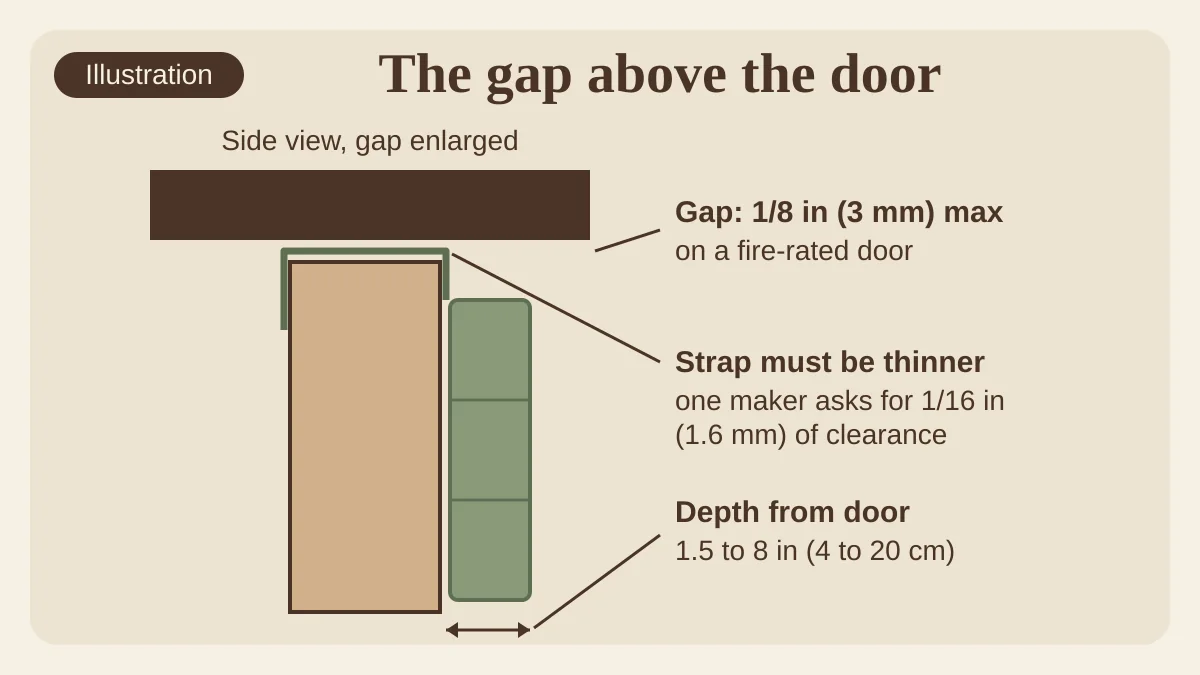
Thickness is only half the fit. The hook’s strap also has to pass through the gap between the top of the door and the frame. On a fire-rated door (a door built to slow fire and smoke, with a label on its hinge edge), NFPA 80 limits that gap to about 1/8 in (3 mm), so a thick or padded strap can stop the door latching.
One steel two-hook hanger is listed for doors up to 1.375 in thick, and its maker asks for at least 1/16 in (1.6 mm) of clearance so the door can close with the hook in place.
| Option | Decided by | Door thickness it fits | Depth from door | Weight limit |
|---|---|---|---|---|
| Single or double hook | Door thickness | Up to 1-3/8 in (35 mm) on most; some list 1-3/8 to 1-3/4 in (35 to 44 mm) | About 2 to 4 in (5 to 10 cm) | 4.4 lb (2 kg) per hook on one steel model |
| 24-pocket organizer | Weight per pocket | Often listed only as “standard doors” | 1.5 to 4.5 in (4 to 11 cm) | 15 to 40 lb (7 to 18 kg) total, about 0.6 to 1.7 lb (0.3 to 0.8 kg) per pocket |
| Basket rack | Depth from door | Often ships with two hook sizes; check which matches | About 6.25 to 8 in (16 to 20 cm) | 8 lb (3.6 kg) per basket, 50 lb (23 kg) total on one 6-basket model |
What the table does not show
Many pocket organizers say only “fits standard doors”, which means the home size, 1-3/8 in (35 mm). If your door is 1-3/4 in (44 mm) and the spec sheet does not name that number, plan on the hooks being too narrow.
Hook fit and weight per pocket
A hook fits when its opening matches your door’s thickness, not just when it is bigger. A pocket organizer is only as strong as its total weight limit divided by its pockets.
Opening size, as a number
Look for a stated range: up to 1-3/8 in, or 1-3/8 to 1-3/4 in. A hook made for a 1-3/4 in door hung on a 1-3/8 in door leaves 3/8 in (10 mm) of slack. The hook tips forward and knocks every time the door moves.
Weight per pocket
Divide the total limit by the pocket count. A 24-pocket organizer rated 15 lb (7 kg) total holds about 0.6 lb (0.3 kg) per pocket; one rated 40 lb (18 kg) holds about 1.7 lb (0.8 kg). Weigh your heaviest pair of shoes on a bathroom scale before you choose.
Weight per hook
Limits are per hook. One steel hanger is rated 4.4 lb (2 kg) per hook, so weigh a loaded backpack before you hang it.
Pocket count barely matters
Twenty-four pockets sounds like a lot. Makers rate a 24-pocket shoe organizer for 12 pairs, one adult shoe per pocket, so count pairs, not pockets.
Key terms, explained
These three terms decide fit, and spec sheets rarely explain them.
- Door thickness
- The distance from one face of a door to the other, measured on its top edge. Home interior doors are usually 1-3/8 in (35 mm); commercial doors are 1-3/4 in (44 mm).
- Head clearance
- The gap between the top edge of a closed door and its frame. On a fire-rated door, NFPA 80 limits it to about 1/8 in (3 mm).
- Fire-rated door
- A door built and labeled to slow fire and smoke for a set time. The label is usually on the hinge edge, and the door must close and latch on its own.
Mistakes to avoid
The most expensive mistake is buying for a home door: a 1-3/8 in (35 mm) hook will not go over a 1-3/4 in (44 mm) dorm door. Read the thickness on the spec sheet, and measure the actual door.
- Forcing a strap into a tight gapIf the door needs a push to latch with the hook on, take the hook off. A residence hall door that does not close fully is a safety problem, and housing staff treat it as one.
- Forgetting the door has to openA 6.25 in (16 cm) basket rack on the back of a door that opens against a wall stops the door before it reaches the wall and narrows your doorway. Measure the space behind the door first.
- Skipping your school’s rulesSome colleges ban specific over-the-door items. Ithaca College lists over-the-door mirrors as prohibited decorations in its apartments. Read your school’s room guide before you pack.
Frequently asked questions
Do over-the-door hooks fit dorm room doors?
Only if the hook is made for that door’s thickness. Many dorm doors are commercial-grade and 1-3/4 in (44 mm) thick, while most over-the-door hooks are made for 1-3/8 in (35 mm) home doors. Measure the top edge of your door, then buy a hook whose spec sheet names that thickness, such as 1-3/8 to 1-3/4 in.
Will an over-the-door organizer stop my door from closing?
It can. The hook strap has to fit through the gap between the top of the door and the frame, which is only about 1/8 in (3 mm) on a fire-rated door. One hook maker asks for at least 1/16 in (1.6 mm) of clearance. If the door needs a push to latch with the organizer on, remove it.
How much weight can an over-the-door shoe organizer hold?
Usually 15 to 40 lb (7 to 18 kg) in total, based on makers’ published limits for 24-pocket models. That figure covers the whole organizer, not each pocket. Divide by the pocket count: 24 pockets on a 15 lb organizer is about 0.6 lb (0.3 kg) per pocket, so weigh your heaviest shoes before you load it.
Are over-the-door organizers allowed in dorms?
Usually, but check your school’s room guide first. Some colleges ban specific over-the-door items such as mirrors, and some cap how much of a wall or door can be covered with decorations; Ithaca College sets that cap at 20%. Anything that stops a door closing and latching is a problem everywhere.
How thick is a dorm room door?
Often 1-3/4 in (44 mm). That is the standard thickness for commercial doors used in schools and residence halls, compared with 1-3/8 in (35 mm) for most home interior doors. Closet doors can differ from the entry door, so measure each door you plan to use.
What to buy next
Measure your door first, then buy the hook or organizer whose published door range includes your number: 1-3/8 in hardware for a home-size door, and hardware that names 1-3/4 in for a commercial dorm door.
Start with one organizer, and add a second only if the door still closes and latches on its own.
Still deciding? Answer a few questions in Help me choose and Basellia will narrow it down by your space and needs.
Where to go next
- Best folding sewing tablesA work table that folds flat enough to store in a closet when you need the floor back.
- Best folding cocktail tablesA low table that folds away, for a room where every square foot does two jobs.
Sources
- Allegion Knowledge Center, Steelcraft door specifications: standard door thickness, checked
- Allegion iDigHardware, Allowable clearances for fire door assemblies under NFPA 80, checked
- Yamazaki Home, Over-the-Door Hanger – Steel: door fit, clearance and weight per hook, checked
- Ithaca College Office of Residential Life, Apartment Guide: prohibited decorations, checked
Explore


Article engagement
Comments (0)
No comments yet. Be the first to share what you think.
Sign in to join the conversation.